*As a child I was irascible—easily bored, prone to tantrums,
and always on edge. Luckily for my parents, they discovered a cure early on:
books. We’d make weekly trips to the library, where I’d fill up a tote bag with
as many books as it could hold. The bag was always so heavy that I’d have to
schlep it over my shoulder like a bindle, which was only cute because I was at
an age and size when carrying really heavy things was endearing rather than
pitiful.
*I’d check out more than thirty books at a time and finish
them all within a week. I’d often lock myself in my room, finishing seven
novels in a day. I was the kid who read under the table at family dinners and
was told my eyes would melt away for reading in the dark on in the car. I
discovered early on that books had a palliative effect on my otherwise choleric
temperament. Books became for me the tokens of comfort that stuffed animals were for many kids.
Libraries and bookstores were both places of discovery and havens of refuge.
*There’s a part of me that refuses to believe in the
possibility of obsolescence. Will books and libraries soon be, respectively,
the LPs and the record stores that we visit with a nostalgic glance? Are they
already mere emblems of authenticity, marks of a certain “type” of person whose
usage of books and libraries avows a certain devotion to higher principles? Are
libraries soon to be museums of objects rather than places where we go to
borrow books?
*Already, the function of libraries is changing—but then
again, perhaps they, like any institution, have always been dynamic. Many
people have written about the library as a “third place,” a term coined by RayOldenburg in his 1990 book, The Great Good Place. Simply put, a “third place”
is “a neutral social surrounding separate from home and work/school.”
Specifically, Kevin Harris, who writes about libraries as being third places,
writes, “all societies need places that allow informal interaction without
requiring it, places that are rich in the possibility of the safe, mundane
encounter…” Libraries can serve this function, but they should also be distinct
from other places of informal interaction, like cafes and parks, in their focus
and intent.
*If libraries are to survive, then they must be able to adapt
to their own changing functions, or people’s perception of their function—and
capitalize on their distinctiveness from other “third places.” Besides being a
meeting place, the library environment should foster, if not an appreciation
for books as objects of both beauty and experience, an appreciation of reading,
learning, and the pursuit of knowledge. They should expand both the breadth and
depth of intellectual exploration.
*One of my college professors, John Stilgoe—an eccentric man
whose curmudgeonly facade could never truly obscure his absolute brilliance and
kindness—said that the reason why he never sent research assistants to the
library and did all book-fetching himself is because of the serendipity that that happens when scanning bookshelves. In the process of seeking one book, you find another, whether tangential or relevant, that might be even better than the
one you were seeking in the first place. The same is true of a librarian’s
expertise: human knowledge, memory, and association create strands of
interpersonal discovery and sharing that we’ve tried to replicate in our digital
libraries, without complete success. Serendipity is diminished, if not lost in algorithmic
recommendations, and even the most personal of reviews online are less human than in a conversation, in a physical space.
*Can the design of a library, then, facilitate serendipity
and discovery while attracting the masses in an age where digital convenience
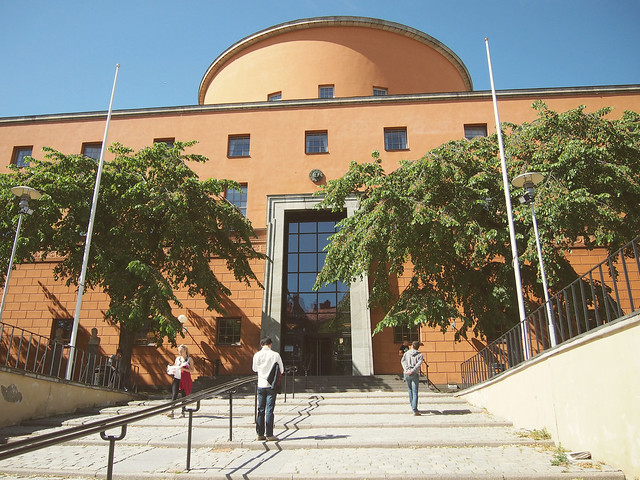
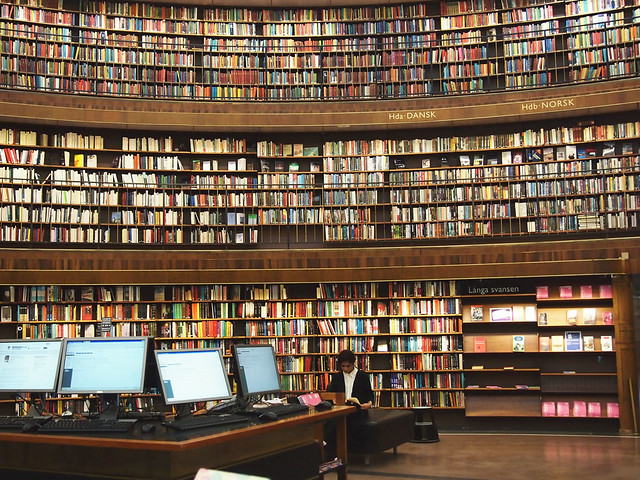
is highly prized and sought after? Last week I visited both the Stockholm Public Library and The Royal Library in Copenhagen, both of which are grand
pillars of design. To the credit of Swedish architect Gunnar Asplund, the
Stockholm Public Library’s most notable feature is its rotunda, which though
remarkable from the outside, is even more remarkable for the experience it
creates for the visitor upon entering the library: the feeling of being
enveloped in books, as in a forest, or a in a crowd. The modern design, which
is both functional and aesthetically pleasing, creates a sense of monumental
grandeur which does not preclude accessibility, which can often be the case in
spaces that feel larger-than-life. In fact, Asplund intentionally implemented
open shelving so that visitors could access books without the help of
librarians; this democratization and access is at the very heart of the
communal book-borrowing system.
*But in a day and age when borrowing books seems antiquated,
if not superfluous, the best libraries serve other functions. One of the
reasons I visited Lamont Library, when I was at Harvard, was to spend time in
the Woodberry Poetry Room, which housed rare archives and recordings. The room
also played host to readings and lectures, which were ends in and of
themselves, but also means for people to become acquainted with library’s
stock. The Seattle Central Library offers a list of the top ten things to do on
its “Plan a Visit” page, which include “Enjoy exciting public art,” “tap into
technology,” and “pick up a gift in the friendshop,” all of which are
extensions, not origins, of a library’s function. The word “library,” after
all, comes from the Old French word “librairie,” which means “collection of
books.” But even if these functions are necessary for libraries to survive,
they must also not eclipse the foundation of libraries: the books themselves.
*I say this because I love and romanticize books as objects.
(My one flash of kleptomania was during the summer before third grade, when I
stole Sweet Valley High books from the summer camp library; never has anything
else even tempted me like books have.) But despite that love, I admit that I am
also obsessed with my Kindle and visit libraries now for their architecture,
aesthetics, sometimes their food, and very often their bathroom, which is true
of my visits to the Stockholm, Copenhagen, and Berlin libraries.
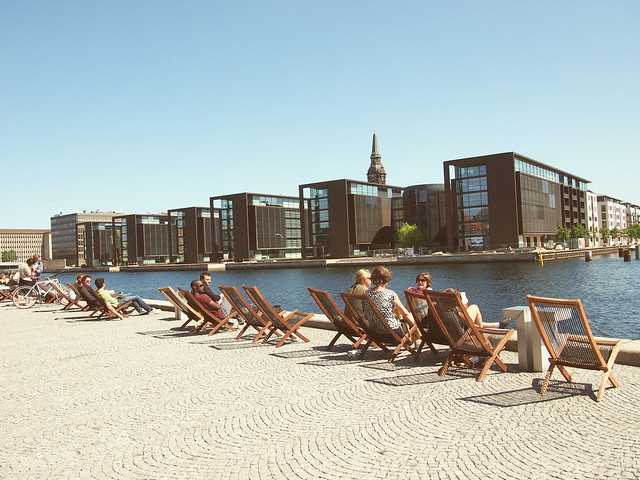
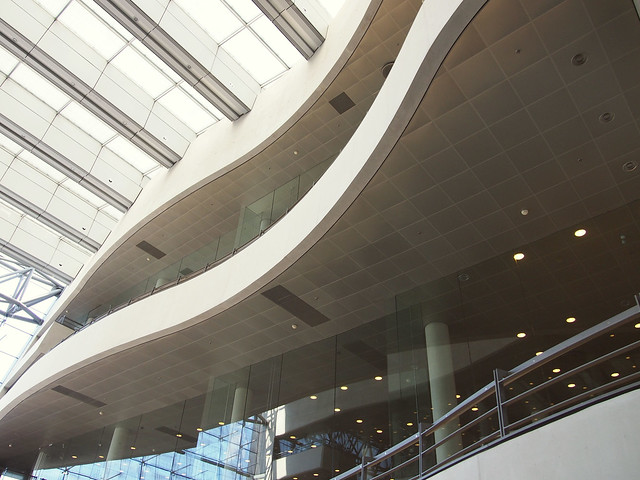
*The Royal Library in Copenhagen seems at first glance to be
a library only in name. Situated on the waterfront, the black marble and glass facade
is a sleek backdrop for tanning in the sun, which is the preferred activity of
many who visit the library. Besides the sun-kissed visitors, the library also
houses a fancy, modern restaurant, a bustling cafe, and a concert hall, all of which could
stand alone, as if the library were a mall or arcade. None seems to need the word
“library” as a descriptor, as in a library cafe, or a library restaurant, or a library concert hall (in fact, those couplings all sound rather awkward), yet
all incentivize visits to the library—at the very least, a reason to
go inside the library after tanning outside. The structure, an eight-story atrium with wave-shaped walls and transversal corridors impresses more easily than its contents. Its modernity is a far cry from the beautiful University libraries I am acquainted with (Widener, most familiarly; Yale's libraries through Gilmore Girls episodes), but its structure's ability to captivate, the same.
*More than ever, we must recognize libraries as places of modernity, not antiquity, that we can utilize in non-traditional ways. It is only in doing so that we can perhaps keep their original purpose, as houses of books, intact. We rarely use the word "patron" anymore, but one of its root meanings, "protector," is an apt word for any book-lover's relationship to libraries, both public and private. In attendance and in finances, I want to patronize libraries. This is my love letter to libraries and the serendipitous discoveries we make inside: the books we find, the knowledge we devour, and the occasional human encounters. This is for all the times that books made me feel better, for all the times I escaped into libraries as a world unto themselves, for all that I've stolen and loved and read and learned. This is my plea to keep libraries alive.
*More than ever, we must recognize libraries as places of modernity, not antiquity, that we can utilize in non-traditional ways. It is only in doing so that we can perhaps keep their original purpose, as houses of books, intact. We rarely use the word "patron" anymore, but one of its root meanings, "protector," is an apt word for any book-lover's relationship to libraries, both public and private. In attendance and in finances, I want to patronize libraries. This is my love letter to libraries and the serendipitous discoveries we make inside: the books we find, the knowledge we devour, and the occasional human encounters. This is for all the times that books made me feel better, for all the times I escaped into libraries as a world unto themselves, for all that I've stolen and loved and read and learned. This is my plea to keep libraries alive.