Showing posts with label movie review. Show all posts

9.30.2013

this is don jon


Joseph Gordon-Levitt writes, directs, and stars in this off-kilter comedy about a porn junkie–a porn junkie who isn't a creepy, fat, old man without a social life. Don Jon, played by Gordon-Levitt is attractive, clean, and suave. He loves his family and goes to church. He spends his days in the gym perfecting his body and nights at clubs scoping out girls with his buds, but no area of his life is as alluring and, in his mind, as necessary as porn. 

Gordon-Levitt very explicitly comments on something that we know to be true but often shy away from addressing: that our reckless consumption media and technology can distort our ideas of romantic relationships. It's both convenient and comfortable for us not to address the effect that porn or chick flicks have. For one, they're viscerally pleasurable; they provide entertainment and relief. More importantly, we know that that if we do address the effects they have on us, we might have to give them up, or worse, we might have to change the frameworks we use to navigate relationships. Because the reality is that both porn and chick flicks enforce a self-centered view of relationships. If we're willing to look beyond that view, well, we might struggle a little bit, because other-centered relationships in which we give to someone else as the expense of ourselves aren't easy. They aren't meant to be.

My best friend and I watched Don Jon in tandem in different cities. She didn't like it. I loved it. She bemoaned Julianne Moore's character, Esther, a grief-stricken widow who copes with her grief in a large empty house by smoking copious amounts of weed. Unlike the other characters in the movie, she is not enshrouded in a larger-than-life persona. She's the clear misfit in the movie, uncomfortably real and awkward, and she's the dark horse that, depending on how you look at it, robs the movie of the seamless, typical rom-com resolution. Esther cries in public, talks to strangers, and sits next to people even when there are other empty seats in the auditorium (I hate that!). But also unlike the other characters in the movie, her understanding of love and relationships is predicated on experience and framed by tragedy, grief, and fragmentation, which is messy but also very real, normal, and dare I say healthy! Onscreen, she is unsettling and disarming because she is so open and vulnerable; unabashed one second and a nervous wreck the next, moving through emotional vacillations that are once senseless and familiar, which makes them all the more painful to watch. 


Esther is the counterpoint to Barbara Sugarman, as played by Scarlett Johansson, who is striking, sultry, and sexy, a perfect ten (a "dime," as Don Jon and his friends call it). Though the plot fixates on the emotional and sexual dimensions of porn addiction, Gordon-Levitt also makes much-needed commentary about how other seemingly innocuous media, like chick flicks, can distort ideals of romance–by glazing over the complexities of relationships or deploying unrealistic narratives that confine gender roles to archetypes or instilling in our hearts and minds that we're to feel a certain way in the throes of romance. The dysfunction in Barbara and Jon's relationship, which is the main development of the first half of the movie is affected as much by Jon's dependence on porn as it is Barbara's ideas of manhood and how a man should serve her in a relationship, as understood through chick flicks.


When Barbara finds out that Jon is addicted to porn, she explodes in anger, yelling and crying and calling him "disgusting." Her reaction is to turn away, as is his, at least initially, when Esther confronts him about his porn habit. We're used to pushing these things under the rug–and I don't mean things like the politics of sex or the glamorized sex that the media sells. I'm talking about the darker side of the human psyche, the unfiltered, raw emotions that send us scrambling for some escape so that we don't have to face ourselves. It's not easy to talk about our addictions or our tragedies or the compulsions that are spurred on by losses and exacerbated by our need to repair those losses. How do we even begin to speak of the desires that give us both grief and pleasure, both shame and relief? Maybe it will never be easy to talk about these things, I don't know. But I think at least giving ourselves a chance, risking comfort and vulnerability for the sake of true intimacy and openness, might be worth it.

5.07.2012

this is me without you

*Sometimes I question our culture's lionization of individualism. On one hand, it pushes us to differentiate ourselves and affirms that it is okay, if not best, to do so. On the other, there exist social norms that bind us to a certain extent of individuation. Our culture's individualism equates dependence with weakness, making the Jack London-nomad and the Indiana Jones -- explorer the heroes of our lives, the characters we should strive to embody. Yet this exhortation to differentiate, when superimposed on a social context -- a context most of us have to and choose to navigate-can result in cutthroat competition, surges of jealousy, and the playing out of Richard Connell's "The Most Dangerous Game." Or are those things just the darkest projections of human nature?

*One of the greatest relational ironies then is the fact that the most intimate relationships are also some of the darkest. Obsessive loyalty and obsequious empathy somehow mandate a counterbalance of treachery and malice, which are all the more treacherous and malicious because of they are subtle and more importantly because they are yoked to the most angelic of virtues.


*Me Without You (2001, dir. Sandra Goldbacher) is a coming-of-age movie that traces the lifelong friendship of Holly and Marina, two girls growing up on the Isle of Wight in the 70s. It is difficult to watch without seeing some of their lives in your own -- moreso the nuances and attitudes embodied in their friendship than the plot itself. You see the imbalances of their friendship: the way Holly always feels mousy and invisible next to Marina and how Marina uses that fact to bolster her own self-image, the way Marina is so needy and can manipulate the shit out of Holly but Holly ingratiates herself to Marina and can see that Marina depends so much on her; but those very imbalances also prove complementary in some good and other sick and twisted ways: they give each other social security; Marina quells the timidity in Holly while Holly tames the wild child in Marina; Holly's calm and balanced family is the antithesis to Marina's unstable and broken household. Yet to reduce the friendship to such simple declarative statements would be too easy -- and false. Every relationship is more complex than that. There are no straight lines, no clear actions, and no easy dichotomy of right and wrong.

*Holly and Marina's friendship is riddled with the anxiety of growing up, the necessary discomforts of discovering and shedding skins, of needing the security found in each other but so desperately wanting security in an identity apart from the other. When uniqueness becomes so personally significant, jealousy also becomes easier, and loyalty feels suffocating. Holly loves Marina's brother but Marina does everything in her power to prevent the fruition of that love, for Holly's loving anyone else, especially her own brother, seems to be a threat not only to their friendship but to Marina's own worth and existence. A manifestation of this horrible tension plays out in the separate, furtive romances that Holly and Marina each develop with the same professor. Each so longs to be loved and desired outside of their friendship. At the very least, each wants to be assured that this is a possibility.


*The thing about friendships is that they are as beautiful as they are messy. They are far from ideal, as I've learned and slowly swallowed. The amount of intimacy often directly correlates with the number of words and feelings left unsaid. Me Without You is not so much about two lives in tandem as it is about the single life formed out of two people, and that is a life so fraught with both love and hatred -- or something that is the combination of the two -- that it can be excruciatingly painful to watch. It's hard to love any of the characters more than another. This isn't a movie trying to further a storybook plot. Instead it sheds light on the delicate complexities of relationships that we can recognize outside of ourselves but are obscured or ignored in our own relationships. At the end of the day, even after the worst of betrayals, Holly and Marina lie side by side with their back on a bed, legs propped up parallel to the white bedroom wall, smoking cigarettes to their toes. They're together, even thirty years later, but this is no fairytale ending. Friendships never are.

*A quote from Jacques Derrida on friendship, taken from my friend Alyssa's thesis on friendship:
"The possibilization of the impossible must remain at one and the same time as undecideable – and therefore as decisive – as the future itself ... but not without suggesting that friendship is implied in advance therein: friendship for oneself, for the friend and for the enemy."

*I'll let you think about that one.

12.28.2011

this is the descendants


*I'll admit I went into The Descendants with high expectations. When I had first seen the preview a month ago, I had told myself, "there's no way in hell I'll watch a movie in which the most action-packed scene is George Clooney blundering down a Hawaiian road in sandals" (yes, I have very specific criteria for movies), but after the umpteenth recommendation to watch it, including many whole-hearted assurances that this was one of Clooney's best performances, I gave in.

(Let me add here that I am not an avid fan of George Clooney, so I'm not sure why this assurance was at all convincing.)

*As a result of my expectations, I spent the duration of the movie waiting. Waiting for a crystallizing moment in which I would feel the weight and pathos of the quiet tragedy around which this movie revolves: a wife and mother's comatose state. But that moment never arrived, and the whole narrative of the movie was underwhelming. Like Little Miss Sunshine, The Descendants seemed to point to the absurdity of ordinary tragedies, like having to steal your dead grandfather's body from a hospital in order to get to a beauty pageant on time (Little Miss Sunshine) or discovering that your unconscious wife was having an affair with a real estate agent of second-degree connection (The Descendants). Both movies explore the interrelational dynamics of families whose dysfunctions were previously buried and unspoken, but finally realized in the wake of a tragedy. But unlike Little Miss Sunshine, there was hardly anything endearing about the characters in The Descendants, who should have been more interesting than they were presented as being. And that's all the more devastating for a movie like this, when as an audience member I want to know a character more, but the character development is so lacking that I'm left in want, a want which eventually dissolves into ambivalence...

*For me, the most palpable emotions of any character were that of Matt King's (George Clooney) father-in-law, a cantankerous old man who gives King grief for being a bad husband and father. It's so obvious to me how some of the deepest sadness can only be manifest through anger and bitterness because we don't know how to distill the sadness in any other manner. There's one scene in the movie where King is being reprimanded by the father-in-law, and the father-in-law is so obviously wrong, but King bears the old man's anger, as if he understands that the most terrible sadness is that a father has in having to face his dying daughter. That, for me, was the most touching scene in the entire movie.


*But aside from random moments, the entire movie seemed non-confrontational. Sometimes a lack of confrontation can be thought-provoking in its modest and understated nature, but for me this movie hardly had the substance or pathos to be that. The witty repartees and one-liners were nice to chuckle at, but as a whole the movie was a jagged and fragmented aggregate that seemed to hold back a little too much.

*But let it be known that I appreciated the Hawaiian shirts, a pattern and texture that carried nicely as a visual motif throughout the entire movie. That was a nice kitschy touch.

12.25.2011

this is shame

*In Steve McQueen's latest film Shame, the sex scenes do not feel frivolous or passionate. Sex in this movie cannot really be equated with love-making, and it certainly is not the fuel for or byproduct of any romance. Instead, it feels violently and strangely ascetic, as if sex, despite its normal linkage with immediate gratification, were a negating act and its repetition an attempt at clarifying the hollowness that was discovered in previous iterations. Whereas sex provides escapism for the characters in Shame, the sexual acts are confrontational for the viewers, and our response is intensely visceral: we oscillate between coiling away and staring back intensely. One moment we are sympathetic, perhaps even empathetic, and the next we are utterly disgusted. This is a movie that is concerned with the psychosis of human nature, the reality of how we unravel as we run away from ourselves.


*Michael Fassbender plays Brandon, a 30-something year old working in New York City. He is unexpressive and piercingly cool, and his life is manicured like the urbane, cosmopolitan version of Pleasantville - if not for his raging sexual needs, which play out like a crack addiction.

*His younger sister, Sissy, played by a haunting and alluring Carey Mulligan, comes to live with him, which disrupts the patterns of his life. Her emotions constantly spill out, whereas his emotions are obscured by the motions of his daily life. She's wrecked and she knows it; he represses his wreckage and tries to wash it all away, through sex, through classical music, through pornography.


*The reason why this movie felt so ascetic, and at times, even antiseptic is not because of the subject matter. In fact, the subject matter makes the asceticism all the more ironic. After all, asceticism is tby definition abstention from worldly and sensual pleasures, and Brandon's "indulgences" are extreme and untempered. But the end-goal of both religious asceticism and Brandon's sexual activities , no matter the derangement of the means, is similar: mind-body transformation and a peace of mind, which some might call sanity. Friedrich Nietzsche wrote an essay called "What Do Ascetic Ideals Mean?" in his book On the Genealogy of Morals in which he discusses the paradoxical nature of asceticism and ascribes it to the category of "Christian decadence." According to Nietzsche, asceticism is a mechanism used to preserve life, to prevent perishing from the pain of life. There's one scene in the movie where Brandon, after a tumultuous night that ends in tragedy, is at the edge of a dock, soaked in rain, fallen on his knees, crying out in anguish. This is one of the most emotive scenes in the movie on his part, and it evokes images of The Scream by Edvard Munch, or that one scene in Little Miss Sunshine when the Nietzsche-obsessed brother discovers he is color-blind and screams his head off in a ditch on the side of the freeway. Whatever the associations, it's a scene that embodies both the raw agony and the sigh of relief that follows a C-section pregnancy - at least that's what it feels like. I mean that seriously.


*The attempts to anesthetize and antisepticize that precede this release reminded me of the emotional tenor that resonates through the plot lines of Anthony Burgess' A Clockwork Orange and Richard Yates' Revolutionary Road (the novel forms of both). Unlikely connections, but the fundamental idea of not being able to face oneself, or not knowing what to do with oneself - an idea that poses a problem without an answer - is present in all three. You find yourself in a helpless body with a mind of its own or a mind out of control; as a result, the characters are more sympathetic and relatable than one might think a sex addict and a wrist-slitting, homeless jazz singer would be. But what propels Shame forward more than anything else are the scenes that are not shown and the words that are not spoken, the ones that are understood but are too violent, too unbearably real to be plotted out onscreen. And somehow, Steve McQueen conveys these absences impeccably, in a way that is more striking and more graphic than any of the sex scenes in the movie itself.

10.31.2011

this is moneyball

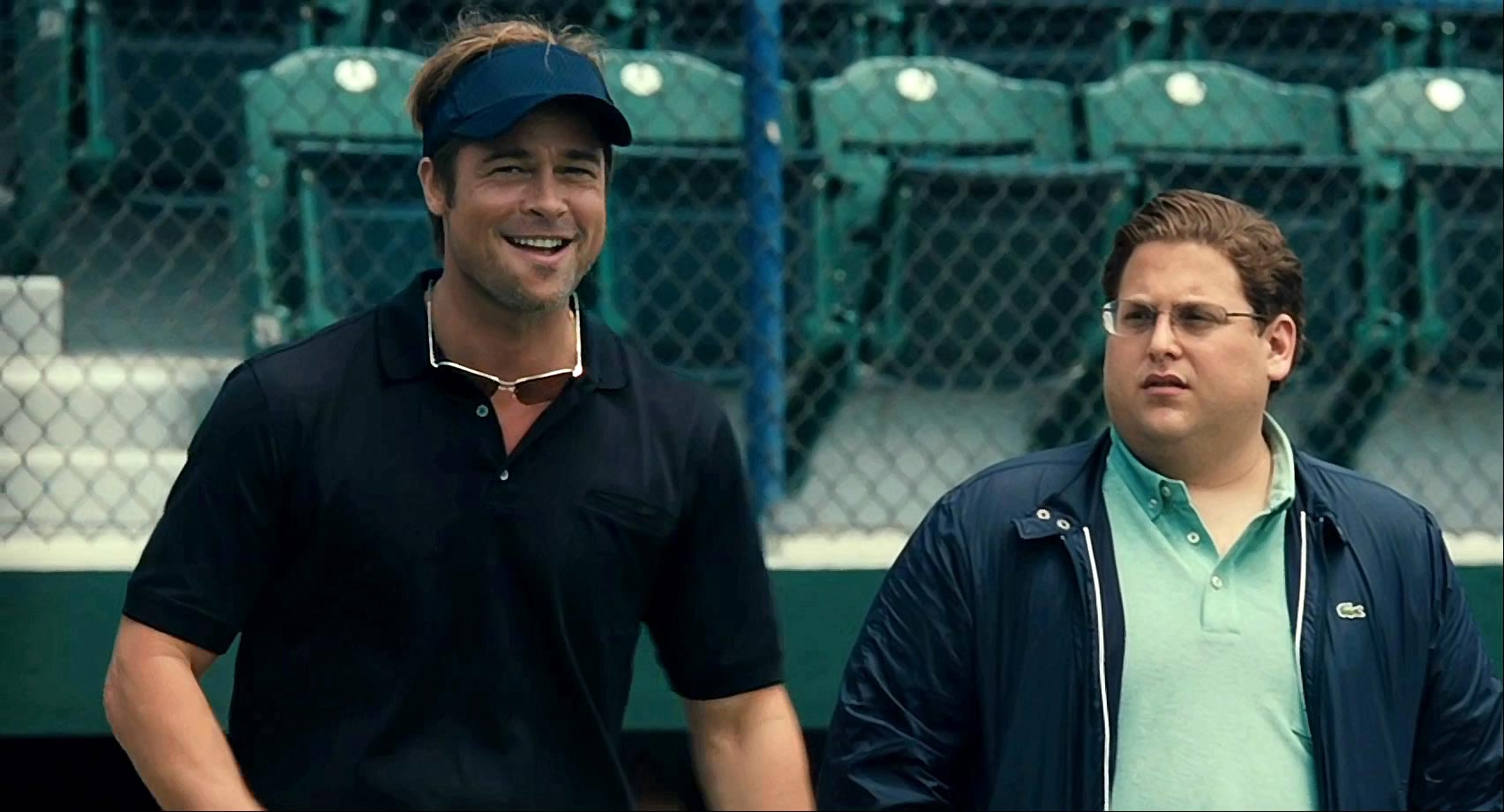
Billy Beane (Brad Pitt) is the general manager of the Oakland A’s, and his biggest problem is putting together a winning team on a minimal budget, especially when teams like the Yankees and Red Sox are buying out his most valuable players. Billy is tired, frustrated, and resigned to the fact that the flow of money also determines the flow of the “best” players, so when he comes across a new method of configuring baseball teams through statistical analysis, he instantly latches onto it. This new method comes by way of Peter Brand (Jonah Hill), who is pudgy and socially awkward and has recently graduated from Yale with a degree in economics.


The plot is highly predictable but enjoyable. Billy Beane’s new methodology goes against all traditional processes of choosing players, which not only upsets the scouts but brings him negative press—in part because if Billy does succeed, the entire game of baseball is threatened: the fear that sport is not about talent but about statistics would be realized. Yet his methodology does succeed in part—and Peter Brand helps him realize this success.

Beyond the plot however, the most compelling part of the movie was the character development of Billy Beane and then Peter Brand, who is in some way Beane’s foil. Billy Beane is past the brink of glory, a could-be baseball success story who failed miserably after choosing the big leagues over a college education. Still, Billy Beane is the “cool guy,” who is brash, hard-headed, and at times unwieldy. Peter Brand is brainy without Beane’s brawn, and he is initially portrayed as timid and meek. But what I found interesting was the way each character’s confidence was unraveled: Beane’s confidence is so concentrated at the surface—in his interactions with the scouts, in his brazenness, in his quick decisions—yet he is unable to let go of his failed past. This inability is probably the biggest blow to his confidence. Brand, on the other hand, is taciturn not because of a lack of confidence in his beliefs, but a lack of courage that impedes action (and his character reeks of repression). Beane and Brand are at once foils and complements, and they educate one another in both explicit and implicit ways. Sometimes Brand’s character felt two-dimensional though, and I wanted to see more of him—I wanted more complexity and depth. But for what it’s worth, as someone who has little to no interest in baseball, this movie kept me engaged all the way through—much thanks to Billy Beane and Peter Brand.

10.21.2011

this is marcy may martha marlene


The Catskills. I think about that life sometimes. A life away from the city, out of suburbia, the kind of pastoral life I could find on a patch of land somewhere far from civilization. Anonymity but not the faceless anonymity of urban streets. No, I'd be tucked away somewhere, in a community, living day to day, doing simple tasks like cooking and cleaning and gardening. Quiet nights with guitar-playing and singing. Summer afternoons spent jumping into swimming hole with no clothes on, floating around in the water with other bodies feeling free and unhindered.

This picture of Arcadia is fully realized in Sean Durkin's movie Marcy May Martha Marlene. Every individual part of this Arcadia is present, yet there is something terribly wrong with this commune. At first, what we see of the commune seems merely outdated: the women are dressed in cloth-like sacks, the men in overalls; the house is dirty and wooden, and the women can eat only after the men finish doing so. But the gut feeling that there is something sick and twisted happening becomes increasingly palpable as the movie winds its way through what should be placid, bucolic images. You think to yourself that in theory, asceticism should be purifying, it should be peaceful, but what is asceticism that violates in the most terrifying, gruesome of ways? What is devotion if it it is disgusting and dignity-wrenching? And the quietness of the Catskills is haunting because you know it has the power to dwarf even the most curdling of screams - the scream that is the cry for help, the scream that devolves into a hellish gnawing.

That's what I felt during the entire movie - a hellish gnawing, brought about less by the explicit acts of sexual violence, more by the silent acceptance of it all, and mostly by the indelible nature of memory. Martha (played by Elizabeth Olsen), who is also Marcy May (her name given to her by the leader of the cult-like commune) and sometimes Marlene (the name that must be given when answering the telephone in commune) escapes the cult life and winds up in the pristine lakeside house of her older sister Lucy, whom she hasn't seen in two years. However, Martha's physical escape precludes a true mental and emotional escape, and the movie is a series of scenes that flow seamlessly between the life she left behind and the life she is trying to adopt. Even her name changes from place to place (and in this movie, name signifies ownership), and her sense of self is lost somewhere between the two. How terrifying it is that the most ordinary activities and objects and sounds become nasty triggers for a past-life that was, on the surface, dream-like, and at its essence, nightmarish. Her paranoia feels like delicate glass that is about to crack, and she is always teetering on the edge of reality - mainly because the realities of her past and present are indiscernible. At one point in the movie, Martha asks Lucy, "Do you ever have that feeling where you can't tell if something's a memory or if something's a dream?" 


The emotional narrative of the movie is complicated by both the juxtaposition of the grotesque and serene as well as the conflation of the two. It seems almost subversive that one can be injected into the other or pass from one to the other so breathlessly. Like cutting from a rape scene to one in which the rapist is singing a sweet folk song for the girl he raped. And how bodies can be so free and unhindered and be so dominated and tamed at the same time. Martha's transition away from the cult is difficult because her memories of the past two years are layered and complex, and there is no gauge for what is truly "normal" anymore - because even in the bourgeois comfort of the lake house, there is something so stifling and strange about "normal" life: the standards that govern propriety and behavior are in some ways more restrictive and narrow than those from her previous life, and so many of the quotidian rhythms: the house chores, the swimming, the gardening - those are all the same.

When you watch Marcy May Martha Marlene you are swept into both a landscape and a mindscape, the former so idyllic and picturesque, the latter so raw and unrefined. Interweaving the two together is unsettling; existing in both simultaneously is absolutely terrifying.

(*Elizabeth Olsen is absolutely magnetizing onscreen. The quiet, glazed-over countenance, the bottling of emotions that want so desperately to erupt, the way her body moves and hangs and flops, how her terror becomes your own - these are all thrilling and captivating.)