Showing posts with label the good life. Show all posts

9.11.2013

this is an onion meditation

onions

To practice patience, I caramelize onions.

Caramelized onions are a delicacy well worth the wait. Not like standing outside a supposedly "amazing" brunch spot on a Saturday afternoon for two hours, only to be served soggy hash browns and half-assed rubbery eggs. Not like sitting on the SF muni for three times as long as you thought you would be and getting punched in the face and yelled at by some crazies before getting to your final destination. You see, learning patience is a work in progress.

(Don't get me wrong I do still have a soft spot for the SF muni, but I hate waiting in line for brunch.)

Luckily, those ambrosial, browned, and perfectly unctuous onions always taste as good as I remember.

The raw material you begin with, a round onion with crackly and peeling skin, keeps expectations low. An onion is a homely-looking thing, always a little dirty and rough. Very common. Used for soups and peasant stews. Sauteeing an onion is the beginning of a good stir-fry, but it's not an act that requires much thought or expertise. It's practically perfunctory.

On the other hand, caramelizing onions is a luxury, of both time and of the senses, a meditative act in the kitchen. By meditative, I mean it brings you into the consciousness of the onion, the slow gradations of its appearance and aroma as it makes contact with slow, relentless heat. Those slivers, little sunbathers basking in a shallow pan of oil. 

From the beginning, the onion awakens your senses. Begin slicing the onion, and do not turn your eyes away. Wear goggles, hold a lemon in your mouth, or confront the onion head-on, welcoming the sharp and turning odor that it diffuses into the air.

Scoop up the onion slices and drop into a heated pan of oil. Turn the heat down low.

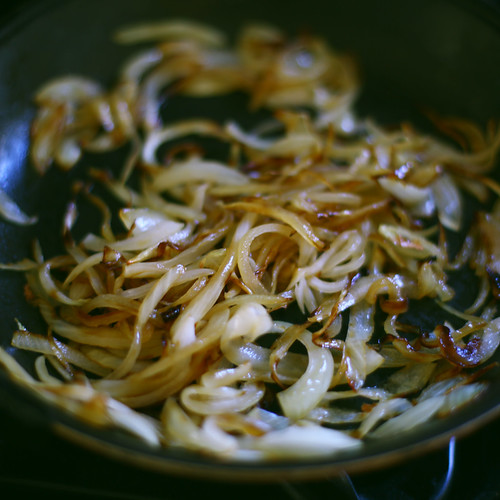
At first contact, the onion jumps and sizzles. The hot oil pricks, a tingling surprise. The onion soaks up the oil, causing its flesh to loosen up. Soon its translucence will render softness. Then it begins to sweat, releasing water, the second round of onion tears. Its aroma is now the product of tears, rather than its cause. That familiar scent, the faint sweetness of onion sweat, cues you to turn on the kitchen fan.

You will be tempted to leave the onions momentarily and attend to some less important matters, distractions. Do as you must, but beware of the onion's fragility when it is left on the stovetop unattended.

You'll return to find dark edges on your onion slices, the fire's fray, perhaps darker than what is ideal, but continue on, gently nudging the onion slivers around the pan with your spatula, pushing them from one side to another. Let your spatula tread delicately, avoiding abrupt scraping. Shriveled slivers, previously unnoticed, stick to the side of the pan.

Let the day pass by, knowing you are invested in making your kitchen a hallowed place. Turn off the kitchen lights for a moment. It is okay to let the onions caramelize silently in dark. At least see what it feels like.

You'll know when your onion slivers have browned sufficiently. They will stick together, adhered by a brown syrupy glaze. This glaze is your reward. Savor it. You began with so much and you've reduced it, from light to dark, from raw and untamed, to soft and wilty and sweet. But don't be fooled by the mere handful of caramelized onions you now have. Caramelized onions are like caviar, to be doled out in small portions, to be known and proclaimed as special. In your mouth, the taste will confirm this as true.

You've been here awhile, and now it's time to move on. Open a window, drink some water. Let the caramelized onions cool, and enjoy the steady peace that the act of caramelizing onions has washed over your entire being. It may not last for long.

6.20.2013

this is fika in the fabric of our lives


*In Swedish, fika means “coffee break.” Fika is a coming together of friends for coffee and something sweet. It isn’t an occasional occurrence; it is a daily habit that is woven into the fabric of people’s everyday lives. Fika is taken before work and after work, sometimes in the late morning or afternoon, other times in the evening. It bookends and breaks up the day. There’s no one mandated time for fika, only that it is taken regularly, gladly, and deliberately, with friends.

*In every society and culture, people come together to share food and drink. Fika ritualizes this idea, making coffee and pastry into a social institution that is distinctive in its casual, frequent, but still intentional nature. Its ordinariness means that it can be seamlessly woven into daily life, a sort of mini-communion taken over and over again throughout the day. It is the breaking of bread and the drinking of wine, secularized, but still symbolic: of friendship, of solidarity, of community, of pause from work, of the value of people and camaraderie, of the small but meaningful moments that sweeten and deepen relationships.

20160604-breakfast

*In Helene Anderson’s book The Swedish Table, she writes that fika establishes friendships and social circles; it is never romantic, but it is a marker of whom you care about and who are the pulses in the rhythm of your life.


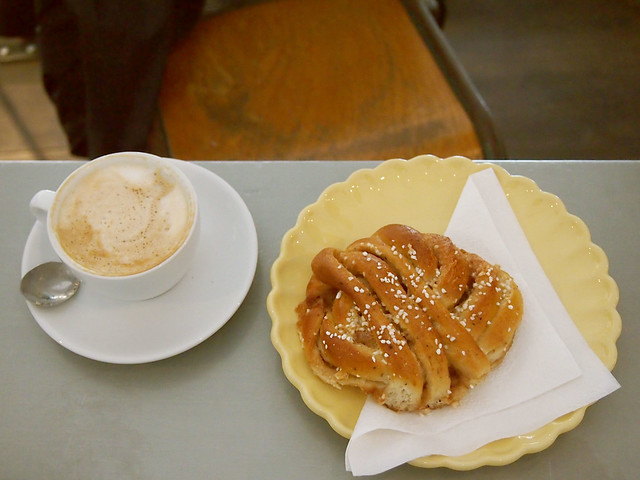
*What is the physical substance of fika? At its most basic, coffee and a Swedish pastry, like a kanelbullar (the Swedish version of a cinnamon bun) or a cardamom bun, both of which are yeasty and doughy, less buttery than a croissant, and not too sweet. This is a classic pairing of a bitter drink with a sweet food, which strikes the kind of balance that neither can achieve alone: merely caffeine-fueled, on one hand, or purely indulgent, on the other.

20130604-fabrique2

*It seems that every culture has its version of a social non-meal that consists of complementary food and drink. In Italy, men stand around espresso bars with un caffe e un cornetto or biscotto in hand, chatting about the business of the day. In South Africa, the pastry-drink combo of choice is a rusk (similar to a biscotti but larger and more cake-like) and rooibos tea. Taiwanese breakfasts feature youtiao (a Chinese cruller, literally meaning “oil strip”) dunked in hot homemade soymilk. And of course, dim sum, a style of Cantonese tapas, is the food component to a much larger Hong Kong institution, yum cha, which literally means to “drink tea.” Going to yum cha means that you’re eating and drinking tea (usually of the Jasmine or Chrysanthemum variety) with friends and family, carrying the same social implications as fika. And of course, the ceremonial British tea time, which can be casual or breathtakingly lavish, is another social ritual with complex codes and etiquettes that bears social, political, and economic weight.

20130604-fabrique

*In The Writing Life, Annie Dillard writes, “How we spend our days is, of course, how we spend our lives. What we do with this hour, and that one, is what we are doing.” Though the passing hours of our day may seem insignificant, I’ve come to find that the quality of my life is often determined by the interstitial moments, the small transactions that may seem mundane but become the threads that connect all the different parts, people, and places in my life. How we break up our days, for instance, might end up being the anchors around which we float. 

*If we take a cue from the Swedes and transform our coffee breaks from a time of zoning out to a time of honing in on the relationships in our lives, maybe the quality of our lives will be that much better—for it’s often not the major life events that determine whether we pass our days well. It’s the daily sustenance that we take in with our minds and our senses, our hearts and our souls; the bread we break and the coffee we drink with our friends; the kinship in which we partake when we sit down, for just an hour, to shoot the breeze with a friend.